
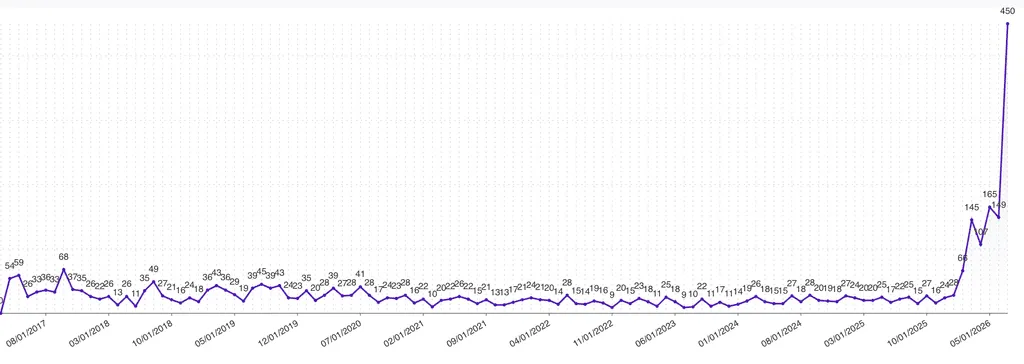
For nearly a decade, WordPress’s bug bounty program on HackerOne took in 10 to 30 vulnerability reports a month. In July 2026, that number hit 450. AI tools are the reason, and it’s a trend every WordPress site owner should understand, because it means more security patches, more often.
What happened
WordPress Security Team lead John Blackbourn shared the report volume data alongside WordPress 7.0.3, a security release we covered earlier today that fixed 12 vulnerabilities. Security firm Patchstack, which published its own analysis of the release, included Blackbourn’s chart: report volume held flat in the dozens for years, then climbed past 100 a month this spring before hitting 450 in July.
Two of the 12 vulnerabilities fixed in 7.0.3 were reported directly by AI companies rather than individual researchers. The most serious flaw, a login screen bug that could be escalated to remote code execution, came from pwn.ai, a firm that runs autonomous AI penetration testing. A separate bug that let attackers bypass WordPress’s safe CSS filter was reported directly by Anthropic. A privilege escalation bug on multisite networks was reported by Aikido Security, a DevSecOps company.
Patchstack’s take: AI-assisted research used to mean a human researcher using a model as a fast assistant. Now the model finds the vulnerability and can carry the finding all the way to a working exploit, leaving the researcher to just report it. That shift, plus more advanced models built for security research entering wide use, is what’s driving the report count up.
Not every one of those 450 reports is a real, unique bug. Blackbourn’s count includes duplicate reports that pile up once multiple AI tools land on the same issue, along with reports of varying quality. But the number of real, valid vulnerabilities being found is still rising sharply.
What this means for your site
More reports means more real bugs getting caught and fixed before attackers find them first, which is good news overall. But it also means WordPress core and plugins will likely ship security patches more often than you’re used to. The best defense is the boring one: keep automatic background updates turned on, and don’t put off manual updates when a security release lands.
This surge follows WP2Shell, the critical remote-code-execution flaw a security researcher found using an AI tool last month, which drew over 11 million exploit attempts once it became public. That discovery got wide attention in the security industry, and Patchstack’s read is that other AI labs and pentest firms have been racing to match it on WordPress ever since.
End of article